Date:
With the AI Value & Performance Framework we present a structured model that helps compa-nies move from initial quick wins to in-depth implementation of AI.
Many companies invest heavily in Artificial Intelligence – yet in most cases, business success re-mains missing. A recent study by MIT shows that only 5% of companies manage to integrate their AI initiatives in a way that generates real added value, while the majority remain stuck in the pilot phase and fail to achieve a measure ROI (Source: State of AI in Business 2025, MIT, 2025).
The key challenges that hinder the implementation of AI initiatives include the following:
- Lack of prioritisation: Without a clear selection and focus on high impact cases, initiatives fall short in their potential
- Unclear objectives: Given the numerous possible use cases, companies often lack clarity about where to start – and thus also the focus on how AI can quickly create added value
- Lack of responsibilities and structures: If clear roles, processes and responsibilities are miss-ing, AI remains without direction within the organization and risks cannot be effectively ad-dressed. Especially after initial initiatives, this often leads to open issues not being addressed consistently – instead of using them as learning opportunities, many companies lose momen-tum.
- Overwhelmed by technology: If the focus is too strongly on technical elements without taking organisational and human factors into account, friction losses and a lack of acceptance arise.
This brings a key question to the fore: How can companies successfully move beyond the concept and planning phase and quickly generate tangible benefits with AI? The key is to bring technology, organisation and people together in such a way that barriers are broken down, rapid value contributions are realised, and long-term competitiveness is secured.
This is where the AI Value & Performance Framework comes in. It offers practical guidance with four key dimensions that structure the successful use of AI in companies: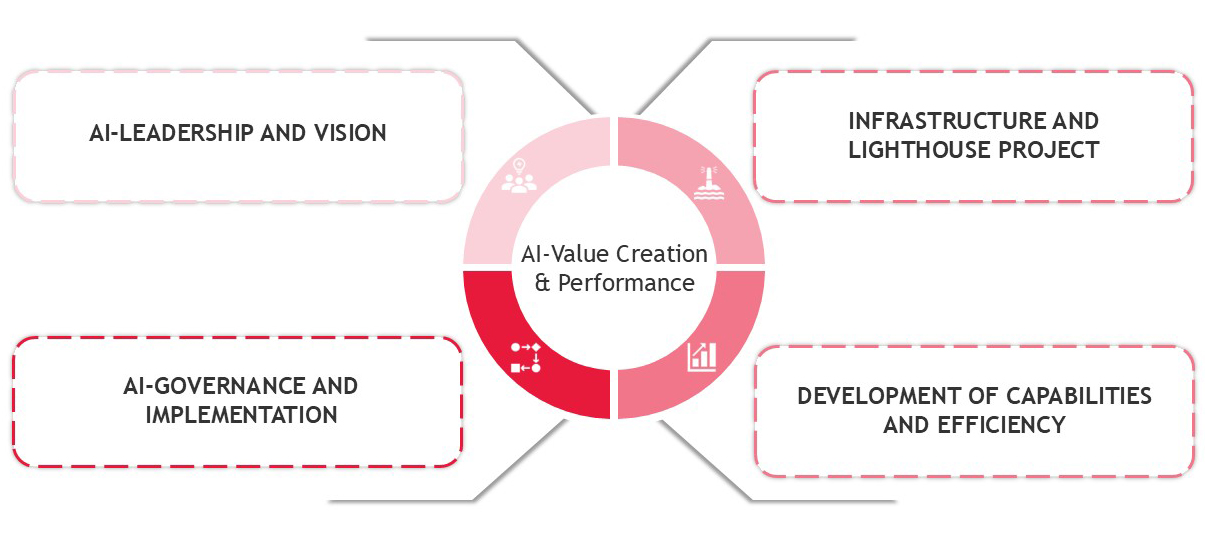
The AI Value & Performance Framework provides the necessary orientation to develop artificial intelligence beyond individual initiatives into a real value driver within the company. It combines strategic leadership with governance, technology and skills – and ensures that investments in AI do not remain in the pilot stage but enable sustainable business success. In this way, AI evolves from an experimental tool to a strategic success factor that strengthens growth, competitiveness and trust in the long term.